With Samson’s story finished, the second major section of Judges wraps up. Chapters 17 through 21 have a different character altogether. They don’t follow the judge-cycle structure, and chronologically they actually describe two independent events that happened earlier in the period. The first is the story of a man named Micah and his personal shrine.
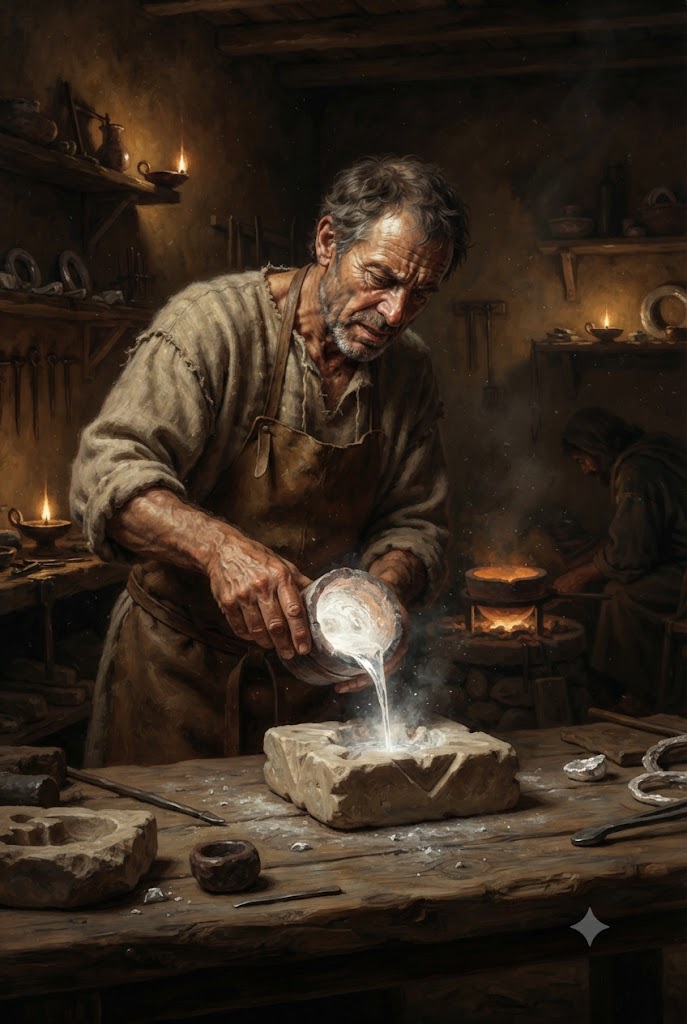
There was a man in the hill country of Ephraim named Micah. He’d stolen eleven hundred pieces of silver from his mother, and when he overheard her cursing whoever took it, he got scared and confessed.
“The eleven hundred shekels of silver that were taken from thee, about which thou cursedst, and spakest of also in mine ears, behold, the silver is with me; I took it.”
His mother takes the returned silver and says, “I had wholly dedicated the silver unto the LORD from my hand for my son, to make a graven image and a molten image: now therefore I will restore it unto thee.” She gives two hundred pieces of it to a silversmith, who makes two images.
What’s striking here is that she calls this act dedicating the silver to the LORD, while doing exactly what Deuteronomy 5 explicitly forbids. Invoking the LORD’s name while doing the very thing the LORD prohibited. That contradiction runs through the whole chapter.
Micah sets up a shrine in his own house, makes an ephod and household idols, and installs one of his sons as priest. Then a young Levite from Bethlehem in Judah, wandering in search of a place to live, arrives at Micah’s house. Micah makes him an offer.
“Dwell with me, and be unto me a father and a priest, and I will give thee ten shekels of silver by the year, and a suit of apparel, and thy victuals.”
The Levite accepts. Micah’s response produces the most striking line in the whole chapter.
“Now know I that the LORD will do me good, seeing I have a Levite to my priest.”
That sentence is worth sitting with. Micah becomes convinced God will now bless him simply because he’s managed to hire an actual Levite for his shrine. Not theological substance, not genuine obedience, just a formal credential he assumes guarantees divine favor. As if the ritual box being checked is all that matters, regardless of what’s actually inside it.
On the surface this whole episode looks quiet, domestic even. No massacre, no war. But the next chapter shows how this seemingly quiet idolatry ends up spreading into something much bigger.
The author of Judges keeps repeating one line throughout this section: “In those days there was no king in Israel, but every man did that which was right in his own eyes.” It doesn’t appear in this particular chapter, but it shows up twice over the next two. Micah’s story is the first illustration of what that refrain actually means. It’s not a problem caused by the absence of a king. It’s what happens when everyone puts their own judgment ahead of God’s clear word.
Tags: #Judges17 #MicahsPrivateShrine #HiringALeviteAsPriest #EveryManDidWhatWasRightInHisOwnEyes #DangerOfEmptyReligiousForm #Judges #BibleDevotional #BibleStudy #OldTestament