Although modern Bibles divide 1 and 2 Samuel into two separate books, they were originally a single continuous narrative divided merely due to length.
This post explores the literary structure and flow of 1 Samuel.
After being liberated from slavery in Egypt and making a covenant with God at Mount Sinai, Israel finally entered the promised land. Though they were called to remain faithful to God and obey His covenant commands, Israel completely failed, as seen in the preceding book of Judges. 1 Samuel answers the need for a wise and faithful leader during this period of moral chaos.
The narrative of 1 and 2 Samuel focuses on three main figures: the prophet Samuel, King Saul, and King David. Through them, Israel transitions from a loose federation of tribes ruled by judges into a unified kingdom ruled by King David from Jerusalem. The book weaves their stories across four distinct sections in an intricate composition. Samuel serves as the central figure and prophet-leader in the first part, while the second part details Saul’s rise, failure, tragic decline, and death. Saul’s dramatic downfall contrasts with David’s gripping ascent. David’s story is similarly divided into his rise to success followed by a fatal failure that slowly unravels his household and kingdom, concluding with a retrospective look at the entire narrative.
The opening section is set against the backdrop of the chaotic period of the judges and introduces a grieving, barren woman named Hannah. Blessed by God, she finally gives birth to a son named Samuel. In Chapter 2, a joyful Hannah breaks out into a remarkable song praising how God humbles the proud and exalts the humble, how He achieves His purposes despite human tragedy and evil, and how He will one day raise up an anointed king for His people. Hannah’s song is placed at the introduction because these core themes echo throughout the entire narrative.
Samuel grows up to become a great prophet and leader of Israel. During a decisive battle against their chief enemy, the Philistines, the Israelites arrogantly rely on the Ark of the Covenant like a magic charm to secure victory instead of seeking God’s help in prayer. Consequently, they are defeated and the Ark is captured. When the Philistines place the Ark in the temple of their god Dagon, the God of Israel strikes the Philistines and Dagon with plagues until the terrified Philistines return the Ark. The core message of this short story is that God is not Israel’s trophy, and He humbles the pride of both the Philistines and His own people. If Israel wants to experience the blessings of God’s covenant, they must always humble themselves and obey.
Next comes the extended narrative where the elders of Israel demand of Samuel, “Appoint a king for us, to judge us like all the other nations.” Though their motives are flawed, God tells Samuel to grant their request. This introduces Saul, a promising yet tragic figure. Tall and handsome, he is the ideal candidate for a king, but he harbors deep character flaws: he is dishonest, lacks integrity, and is incapable of admitting his mistakes. These flaws ultimately lead to his downfall. Though he wins early victories, his deep-seated flaws lead him to blatantly disobey God’s commands, causing him to forfeit his kingship. The elderly Samuel warns Saul and the people that only a king who is humble and faithful before God will bring good to Israel, while unfaithful kings will bring ruin. Samuel also informs Saul that God will raise up a new king in his place.
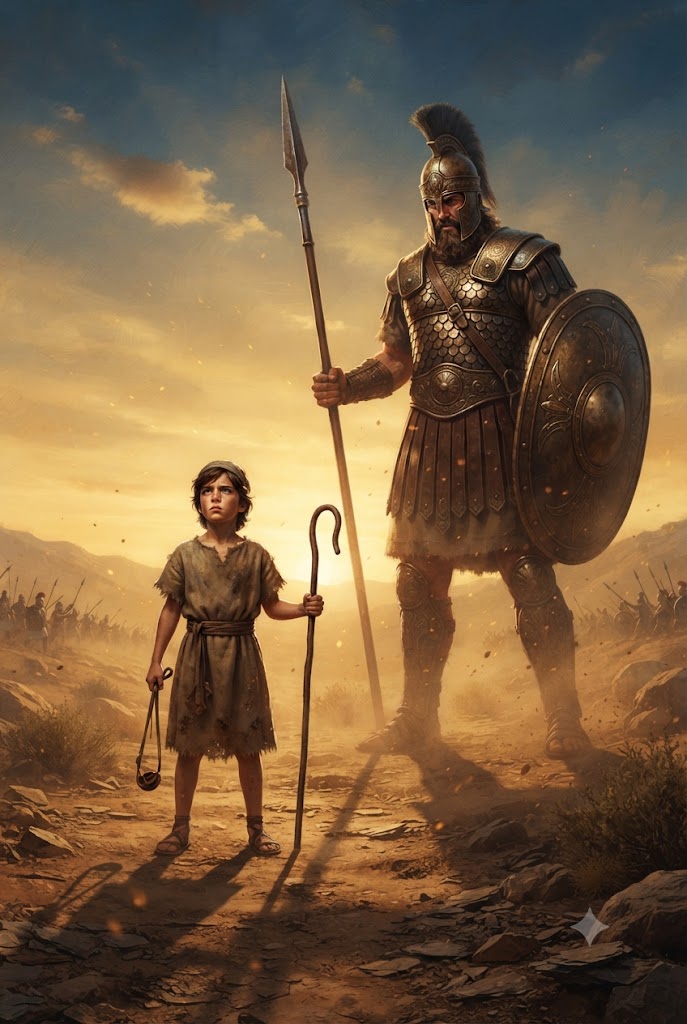
As Saul begins to decline, God is working behind the scenes to establish a new king: the unassuming shepherd boy David, who seems the farthest thing from royalty. However, in the famous story of David and Goliath, we learn that God chooses David not based on his family status, but on his pure and humble faith. This aligns with the themes of Hannah’s song: God brings down the proud Saul and Goliath while exalting the humble David. From this point on, Saul slowly descends into madness while David gains power. David becomes the commander of Saul’s army, winning every battle and earning great fame. In jealousy, Saul hunts David down to kill him. Completely innocent, David flees into the wilderness, trusting that God will raise up a king for His people in His own time. Notably, many of David’s psalms written during this period reflect this unwavering trust. Ultimately, this section concludes with Saul’s defeat and wretched death in a battle against the Philistines.
1 and 2 Samuel offer some of the most complex and sophisticated narratives in the Bible. The realistic portrayal of flawed figures like Saul and David serves as a character study, inviting readers to see themselves within the stories. Saul’s story warns us to examine how our own character flaws affect those around us, urging us to rely on God’s help to humbly deal with our dark sides rather than turning out like Saul. Conversely, David is portrayed as a model of patience who waited for God’s timing. Even while running for his life in the wilderness, when he had every reason to think God had abandoned him, he trusted otherwise. Through David’s story, we learn to trust that despite human evil, God humbles the proud, exalts the humble, and fulfills His ultimate purposes.
Tags: #1Samuel #BookOf1Samuel #Hannah #KingSaul #KingDavid #ProphetSamuel #DavidAndGoliath #ArkOfTheCovenant #BibleOverview #BibleStudy #KJVBible #Christian #Christianity #BibleStory #OldTestament #GodsSovereignty #HumilityVsPride #BibleSummary #FaithJourney