PROLOGUE — Inscribing Victory into Poetry
Judges 5 contains a song poetically retelling the victory of chapter 4 — a text considered one of the oldest pieces of Hebrew poetry in Scripture. An event already narrated in prose is now sung once more, in a form where emotion and theology are compressed together.
ACT ONE — An Overture Toward the Leaders (verses 1–11)
“Praise ye the LORD for the avenging of Israel, when the people willingly offered themselves… Hear, O ye kings; give ear, O ye princes; I, even I, will sing unto the LORD; I will sing praise to the LORD God of Israel.”
The song recalls the majesty of the LORD’s descent at Sinai, and looks back on the extreme suffering Israel had endured before Jael’s time — a time when the highways were deserted, and travelers walked through byways.
ACT TWO — Tribes Who Volunteered, and Those Who Did Not (verses 12–18)
The song sharply contrasts the participation, or lack thereof, of each tribe.
“Awake, awake, Deborah… Zebulun and Naphtali were a people that jeoparded their lives unto the death in the high places of the field… For the divisions of Reuben there were great thoughts of heart. Why abodest thou among the sheepfolds, to hear the bleatings of the flocks? For the divisions of Reuben there were great searchings of heart.”
Great thoughts of heart… great searchings of heart. This expression carries scathing irony — the tribe of Reuben deliberated over joining the battle, but ultimately never acted, remaining instead in comfort (sheepfolds, the sound of flutes). Gilead, Dan, and Asher were similarly noted for their lack of participation.
By contrast, Zebulun and Naphtali actually risked their lives in battle — the difference between the tribes who paid the actual cost of obedience and those who did not was permanently inscribed within this song.
ACT THREE — The Stars Fought, the River Swept Them Away (verses 19–23)
The song poetically describes the supernatural dimension of the battle.
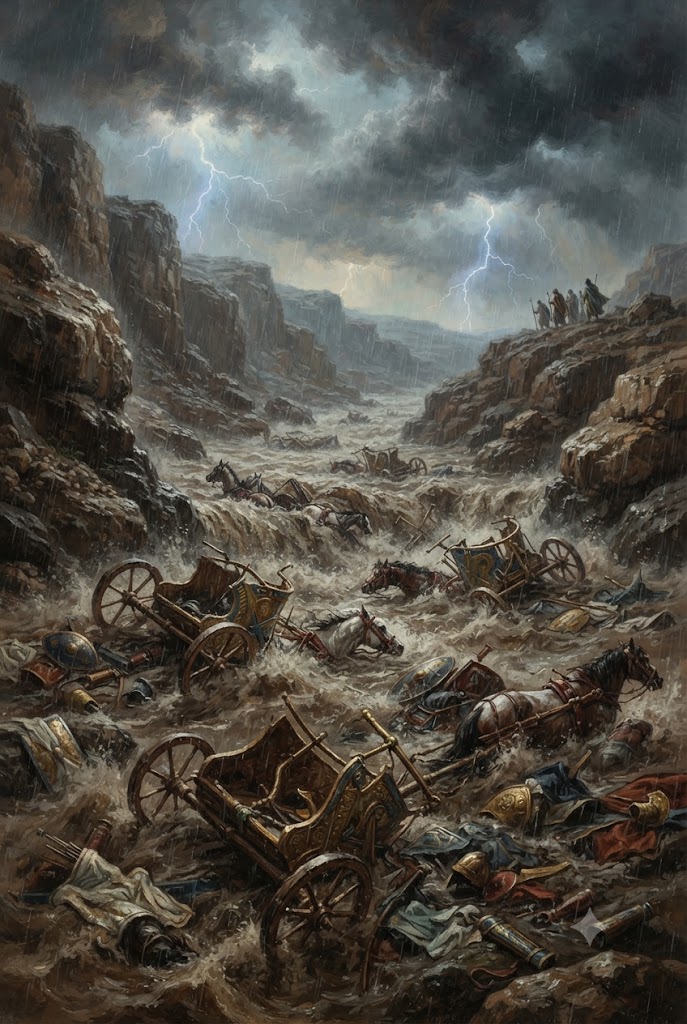
“They fought from heaven; the stars in their courses fought against Sisera. The river of Kishon swept them away, that ancient river, the river Kishon.”
The stars fought from heaven. This poetic image dramatically expresses that the cosmos itself fought on Israel’s side — likely a poetic elevation of a natural phenomenon, where a heavy rainstorm flooded the Kishon River, neutralizing Sisera’s chariots.
A curse follows against those who did not join the battle.
“Curse ye Meroz, said the angel of the LORD, curse ye bitterly the inhabitants thereof; because they came not to the help of the LORD, to the help of the LORD against the mighty.”
ACT FOUR — Praise for Jael, and Sisera’s Mother’s Vain Waiting (verses 24–31)
The song extols Jael in the highest terms.
“Blessed above women shall Jael the wife of Heber the Kenite be, blessed shall she be above women in the tent.”
And after Sisera’s death is described once more in poetic terms, this song closes with a remarkably emotional reversal — a scene of Sisera’s mother, waiting in vain at the window for her son to return with the spoils of victory.
“The mother of Sisera looked out at a window, and cried through the lattice, Why is his chariot so long in coming? why tarry the wheels of his chariots?”
This unexpected human moment — a brief pang of compassion for an enemy commander’s mother — acknowledges the tragic cost of war even within a song of victory.
The song closes with a powerful, twofold conclusion.
“So let all thine enemies perish, O LORD: but let them that love him be as the sun when he goeth forth in his might. And the land had rest forty years.”
REFLECTION — Participation and Bystanding, a Memory Preserved in Song
What Judges 5 teaches us is that the difference between those who actually answered God’s call and those who remained in comfort is never forgotten. The devotion of Zebulun and Naphtali, the passivity of Reuben and Meroz — all of it was permanently etched into Israel’s collective memory.
In the moment God calls, are you becoming someone who actually participates, rather than remaining a comfortable bystander?
NEXT EPISODE PREVIEW
Judges Chapter 6 — the oppression of Midian begins, along with the story of the next judge, Gideon.
Tags: #Judges5 #SongOfDeborah #TheStarsFoughtFromHeaven #ReubensGreatThoughtsAndSearchingsOfHeart #JaelBlessedAboveWomen #SiserasMothersVainWaiting #Judges #BibleDevotional #ChristianBlog #BibleStudy #OldTestament #Bible #Church #Devotion #Christianity #OldestHebrewPoetry #MemoryOfParticipationAndBystanding #DailyDevotional